The old way to get data
Most AI still gets trained the old way. Someone decides what to collect, labels it, cleans it, ships it as a dataset. That’s intentional data. It’s expensive to build and it only exists because someone specifically set out to build it.
A lot of the interesting work happening right now skips that step entirely. It starts with digital exhaust, also called ambient data collection.
The framework
Once you start treating exhaust as a first-class input, one pattern keeps showing up everywhere:
- Sensor - captures something raw
- Observation - that raw signal, a frame, a reading, a log line
- Representation - turns the observation into something structured: features, embeddings, events
- Model - consumes the representation
- Inference - the model answering a question about it
- Action - what happens as a result, which usually loops back and generates more exhaust
The cleanest place to see the whole loop is a car.
Walking the loop through a car
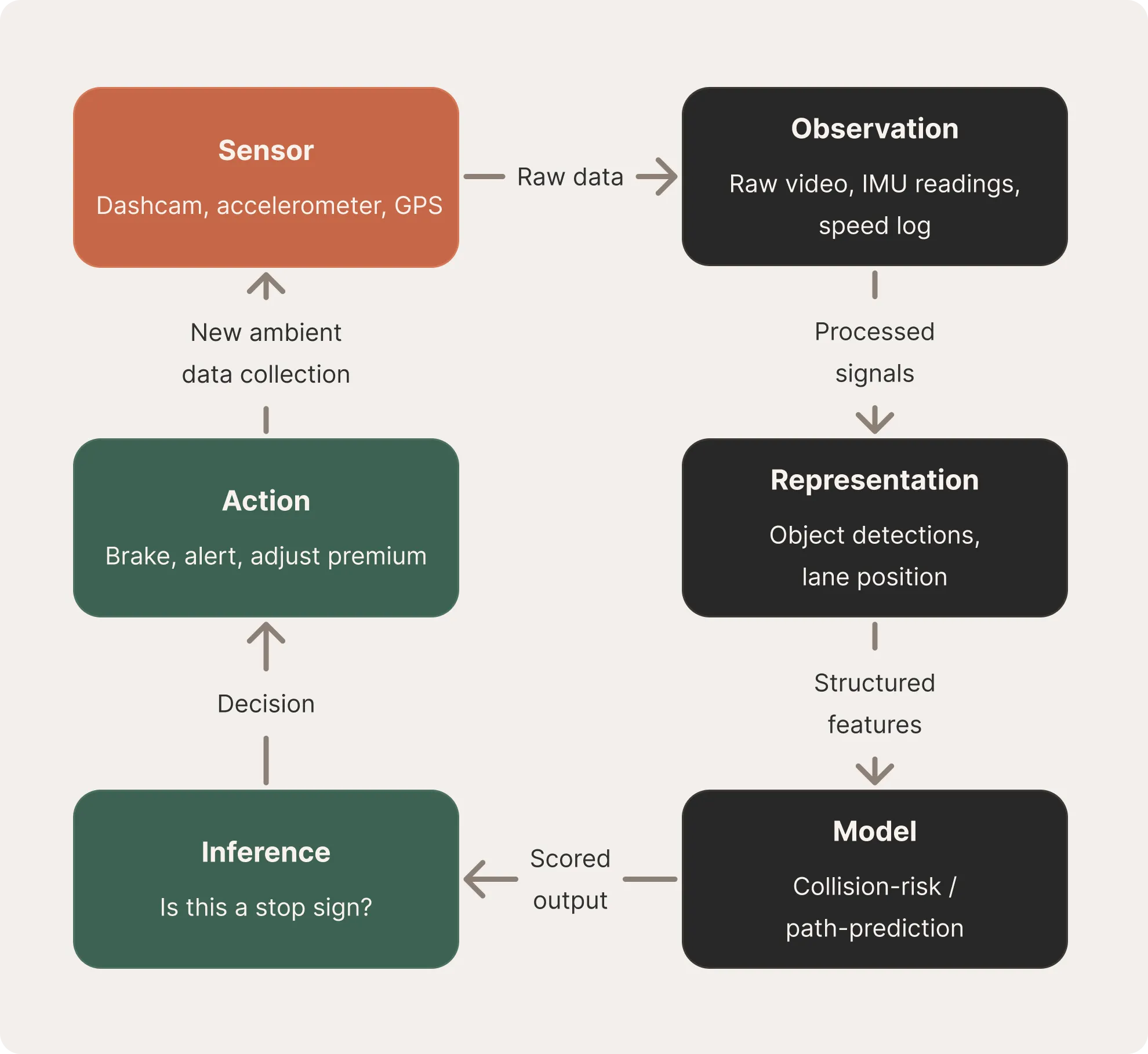 Ambient data collection examples with the car’s sensors
Any modern car is already a rig with a dashcam, accelerometer, GPS, wheel-speed sensors. None of it was installed to train a model, it’s there for lane assist, insurance apps, backup cameras. The sensor already exists, nobody has to go build it.
What comes off those sensors is a raw, messy stream with video frames, inertial measurement unit (IMU) readings, a speed log and GPS pings. At this stage it’s not information yet, just data sitting there, unopinionated about what matters.
Then the stream turns into something usable like object detections in the frame, lane position, a harsh-braking event flagged in the log. Structure gets imposed on the mess. We do the same move on a smaller scale with Deyra. Raw text, unstructured data and interaction data don’t help anyone until it’s turned into embeddings a search and a recommendation system can actually use. Different domain, same step.
Now something consumes that structured signal:
- Waymo and Tesla full self-driving: trained on fleet video pulled from cars already on the road, not a dataset someone assembled by hand.
- Progressive snapshot and root insurance: braking, cornering, speed data and telematics collected straight from a phone or plug-in device feeds directly into a driver’s risk score, in exchange for a lower premium.
The model answers a live question and it has to answer it now, not in a batch job an hour later. Is that a stop sign? Is this driver’s pattern risky enough to flag? Is a collision about to happen in the next half second? Get it wrong here and there’s no next stage to fix it.
Then something happens because of the answer - the car brakes, an alert fires, a premium adjusts. The action itself generates new exhaust, a logged event, a new data point, so the loop feeds itself. Before any of this ships to a real car, it usually gets tested in simulation first.
The pattern shows up everywhere
Swap out “car” for almost anything and the same six steps hold:
- Phones and watches turn steps, heart rate, and sleep into behavior signal. I built a personal project called Voyager (inspired by the NASA Voyager program) to do exactly this on myself: pulling Apple Watch data, notes, activity logs, and weather into one place to see what actually correlates with what, whether a bad-sleep day tracks with a weather front, whether energy dips follow a pattern in the notes. Full loop, sensor to action, except the “action” is just me making a different decision tomorrow.
- Strava does the same thing at a much bigger scale. Years of runs and rides, never meant as a dataset, turned into the Global Heatmap and route-recommendation models almost as a byproduct.
- App and website logs work the same way at the intent layer. Clicks, searches, dwell time, what someone typed and then deleted: none of it is a survey response, but all of it says something about what a person actually wants.
- LLM conversations might be the richest exhaust source yet. A chat log isn’t just text, it’s someone’s actual intent, spelled out in their own words, with none of the ambiguity you get from a click or a search query.
The real shift
None of this is really about better models. Better models help, but they’re not the shift. The shift is upstream - what counts as training data changed. It used to be something you built on purpose. Now it’s something you’re already generating, all day, without trying, and the systems that win are the ones built to notice.